

Grow Guide
A male vs female weed plant is told apart at the nodes, where each branch meets the stem. Between weeks 4 and 6 from seed, a female shows a small teardrop calyx with one or two white hairs. A male shows a smooth round ball on a stalk and no hairs. Females make bud. Males make pollen and get pulled.
This chapter is the sexing step in the grow guide: where to look, when, what each sex looks like up close, what to do with males, and how feminized seeds change the job. What to do when a plant shows both sexes is a problem, not a process, and lives on the hermaphrodites page.
How do you tell if a weed plant is male or female?
Look at the nodes on the upper third of the plant with a loupe or a zoomed phone camera. A female pre-flower is a pointed green calyx with one or two fine white pistils emerging from the tip. A male pre-flower is a rounded sac on a tiny stalk, shaped like a ball or a spade, with no hairs at all.
Two rules make this reliable. First, wait for the hairs: an immature female calyx can look round before the pistils push out, and beginners mistake it for a male every week. Second, check several nodes. One ambiguous bump means wait three days and look again. Three nodes of stalked balls mean a male.
In full flower the difference is obvious: females build sticky clusters of calyxes and pistils that thicken into bud, males build hanging bunches of sacs that open like tiny bananas and dust the room with pollen. The point of sexing early is to never let it get that far.
When do pre-flowers appear?
Pre-flowers appear at 4 to 6 weeks from seed on most photoperiod plants, while the plant is still under 18 hours of light. Males usually declare first, often a week ahead of females from the same pack. Plants started from clone show sex almost immediately because the cutting is already mature; the cloning chapter covers that.
Maturity comes with age, not the light schedule. Flipping to 12/12 at week 3 will not speed it up; it just makes a tiny plant flower. Wait for week 4, then look at the nodes every two days. Indica-leaning plants tend to show earlier and lower on the stem; sativa-leaning plants can hold out until week 7 or 8. The full calendar is on the stages of growth page.
Pictures of male plants and female plants: what to look for up close
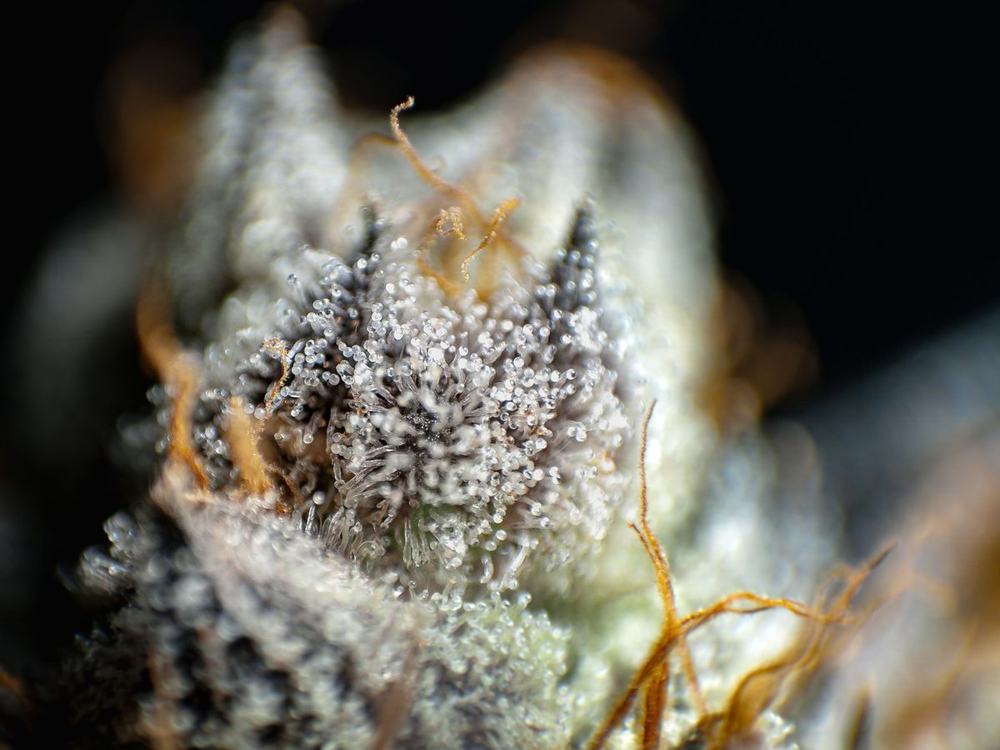
Female pre-flower. A single calyx, green, narrow at the base and pointed at the tip, sitting tight against the stem in the crook of the node beside the stipule (the small leaf-like spike at every node). One or two white pistils stand straight out. Under a loupe the calyx already carries a few trichomes. Over the next week the pistils multiply and the calyxes stack into a cluster.
Male pre-flower. A smooth sac, green to yellow-green, rounded like a ball, attached to the node by a visible short stem. No pistils and almost no trichomes. Within two to three weeks a cluster of five to ten sacs hangs from the node, and when they mature they split open and release pollen. You want them gone long before that.
The stipule trap. Every plant, male or female, has thin green spikes at the nodes that look like tiny leaves. They are stipules, not pre-flowers. Pre-flowers sit in the angle beside the stipule, not in place of it.
Sexing checklist by week
Node checklist, week by week from seed, photoperiod plant under 18 hours of light
| Week from seed | What you can see | Female sign | Male sign | Action |
|---|---|---|---|---|
| 1 to 3 | Nodes and stipules only | None yet | None yet | Nothing; keep growing |
| 4 | First bumps at upper nodes | Pointed calyx, maybe no hair yet | Stalked round ball | Look every 2 days, do not decide |
| 5 | Pre-flowers on 2 or more nodes | White pistils clearly out | Cluster of 2 to 3 sacs on stalks | Tag females, remove confirmed males |
| 6 | Most plants declared | Pistils on several nodes | Sacs enlarging | Cull all males; unsure plants get 3 more days |
| 7 to 8 | Late or sativa-leaning plants show | Same | Same | Final check before the 12/12 flip |
| Flip + 2 weeks | Full flowers forming | Calyx clusters and pistils | Hanging sac clusters | Any male still here is an emergency |
Why a male weed plant gets culled, and what feminized seeds change
Males get culled because pollen makes seeds, and seeds ruin flower. One male can pollinate every female in the room, and a pollinated bud stops building calyxes and puts its energy into seed. You lose weight, potency and quality. Unless you are breeding, the male goes in a bag and out of the house the day you confirm it, and you wash your hands before touching the females.
A male is not worthless. If you want to breed, keep the best one isolated in another room and collect the pollen on paper.
Feminized seeds solve most of this. A breeder treats a female with silver thiosulfate or colloidal silver so it produces pollen carrying only female genetics, then uses that pollen on another female. The seeds are 99 percent or more female, which is why many home growers have never seen a male. It does not remove the need to check nodes: a stressed feminized plant can throw male flowers. Punja and Holmes (2020) documented male flowers in commercial feminized crops and confirmed the pollen is viable and sets seed, so treat "feminized" as "check anyway."
The mistake most growers make when sexing plants
The mistake is deciding too early. A grower sees a rounded bump at week 4, calls it a male, and pulls a plant that would have shown pistils two days later. The reverse is rarer but worse: seeing a bump, calling it female without waiting for hairs, and letting a male open in the tent.
The fix is a rule, not a skill: no plant is female until you have seen white pistils, and no plant is culled until you have seen a stalked ball with no hairs on at least two nodes. If you cannot say which, wait 72 hours. In eighteen years of Dear Danko letters, "I pulled the wrong plant" arrived about as often as "I found seeds in my bud."
Next step: watch the trichomes
Once every plant in the room has shown pistils, sexing is finished. The next thing you inspect with that loupe is the resin: the trichomes chapter tells you when the buds you just protected are ready to cut. If a female shows sacs late in flower, read the hermaphrodites page before you do anything. Cultivation is for adults where it is legal; check your local law before you grow.
Sources
- Punja and Holmes (2020), Hermaphroditism in Marijuana (Cannabis sativa L.) Inflorescences, Frontiers in Plant Science (used for the statement that feminized crops can produce viable male flowers and pollen)