

Plant Problems
Pot leaves tell you what is wrong with the plant before anything else does. A healthy cannabis leaf is flat, evenly green, and held out at a slight upward angle. Read color, position, texture, spots, curl and edges in that order and you can name the cause of almost every leaf problem without a lab.
This is the chart page. It covers the parts of a marijuana leaf, what healthy looks like, and a symptom table that sends each reading to the page with the fix.
Parts of a Pot Leaf
A cannabis leaf is palmate: several leaflets fanning out from one point on the stalk, each with a serrated edge. Fan leaves are the big ones, with five to nine leaflets on a mature plant and up to thirteen on vigorous sativas. Seedlings start with one leaflet per leaf, then three, then five. Sugar leaves are the small, trichome-covered leaves growing out of the bud itself.
The stalk joining the leaf to the stem is the petiole. The pale midrib up each leaflet is the main vein, and the tissue between the branch veins is where most deficiencies show first. Broad, dark, wide leaflets read as indica heritage; long, narrow, lighter leaflets read as sativa. Leaflet count and serration vary with strain and age, so they are not diagnostic (Leafly's grow library covers the anatomy in more depth). Color, texture and position are.
What a Healthy Cannabis Leaf Looks Like
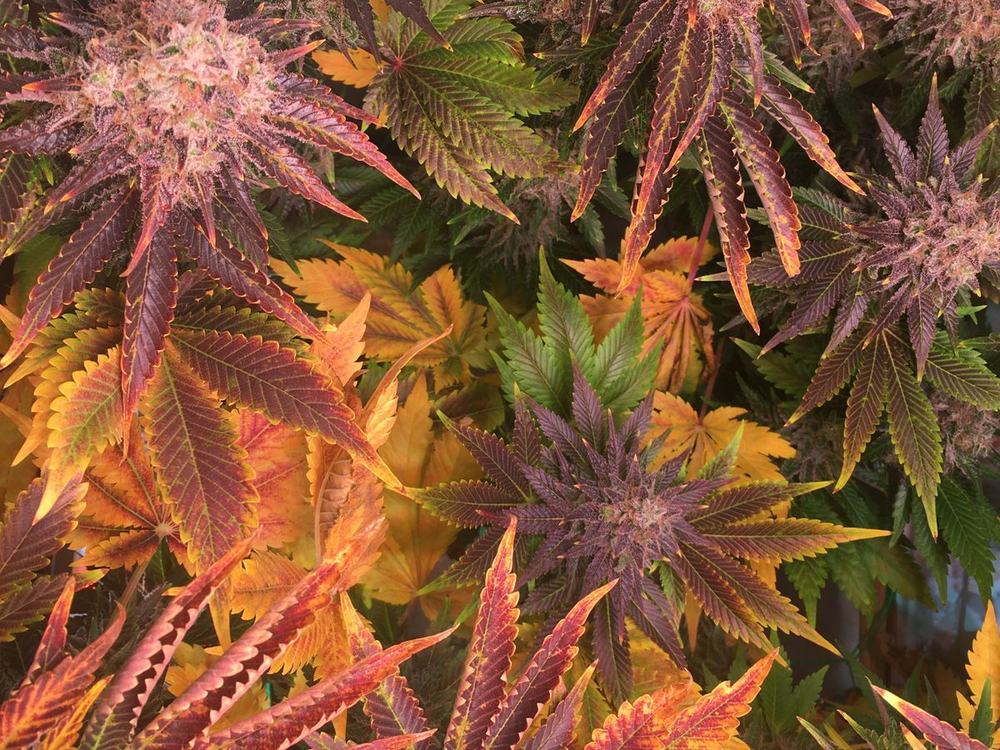
Healthy fan leaves are a uniform medium to dark green, matte rather than glossy, flat from midrib to edge, and angled slightly upward toward the light during the day. Tips are sharp and green. Undersides are clean. New growth at the top is a shade lighter than old growth, and that is the only color difference you should see.
Hold one up to the light. No spots, no translucent patches, no stippling. Rub a finger across the underside; it should feel smooth and dry. Leaves relax and droop a little in the dark period and lift again within an hour of lights on. Under a healthy, transpiring canopy the leaf surface runs 1 to 2 C cooler than the air, and an infrared thermometer pointed at a leaf is the cheapest health check there is.
What Causes Cannabis Leaf Problems
Every leaf problem comes from one of four places: the feed (too much, too little, or locked out by pH), the root zone (drowned, dry, or root bound), the environment (heat, light, humidity), or something eating or infecting the plant. The leaf cannot tell you which. The pattern can. Feed problems follow nutrient mobility, old leaves for mobile nutrients and new growth for immobile ones. Root problems show on the whole plant at once. Environment problems show at the top of the canopy first. Pests and disease show on undersides and in patches.
How to Read Pot Leaves Like a Doctor
Take the six readings in order and write them down before you decide anything.
- Color. Yellow, pale green, dark blue green, purple stems, brown, white powder, or bleached.
- Position. Bottom of the plant, middle, top, or everywhere at once.
- Texture. Crisp and dry, limp and heavy, thick and brittle, or normal.
- Spots. Rusty brown, pale stipples, holes, or halos around a dead center.
- Curl. Edges up like a taco, whole leaf clawing down, or twisted new growth.
- Edges. Burnt tips, scorched margins, or clean.
Leaf symptom chart: reading, location, cause and where the fix lives
| Symptom | Where on the plant | Likely cause | Read this page |
|---|---|---|---|
| Even yellow, whole leaf | Lowest fan leaves first | Nitrogen shortage or normal late flower fade | Yellow leaves |
| Yellow between green veins | Middle and lower leaves | Magnesium shortage | Nutrient deficiencies |
| Brown, crisp tips on dark green leaves | Whole plant, tips first | Nutrient burn, feed too strong | Nutrients chapter |
| Edges curl up, leaf shaped like a taco | Top of the canopy | Heat, or the lamp too close | Heat stress |
| Whole leaf claws down, dark green, limp | Whole plant | Overwatering or nitrogen excess | Overwatering |
| Tiny pale stipples, fine webbing underneath | Undersides, lower leaves first | Spider mites | Pests |
| Rusty spots with a yellow halo | Middle leaves | Calcium shortage or pH swing | Nutrient deficiencies |
| White dusty patches on top of the leaf | Shaded lower leaves | Powdery mildew | Mold and bud rot |
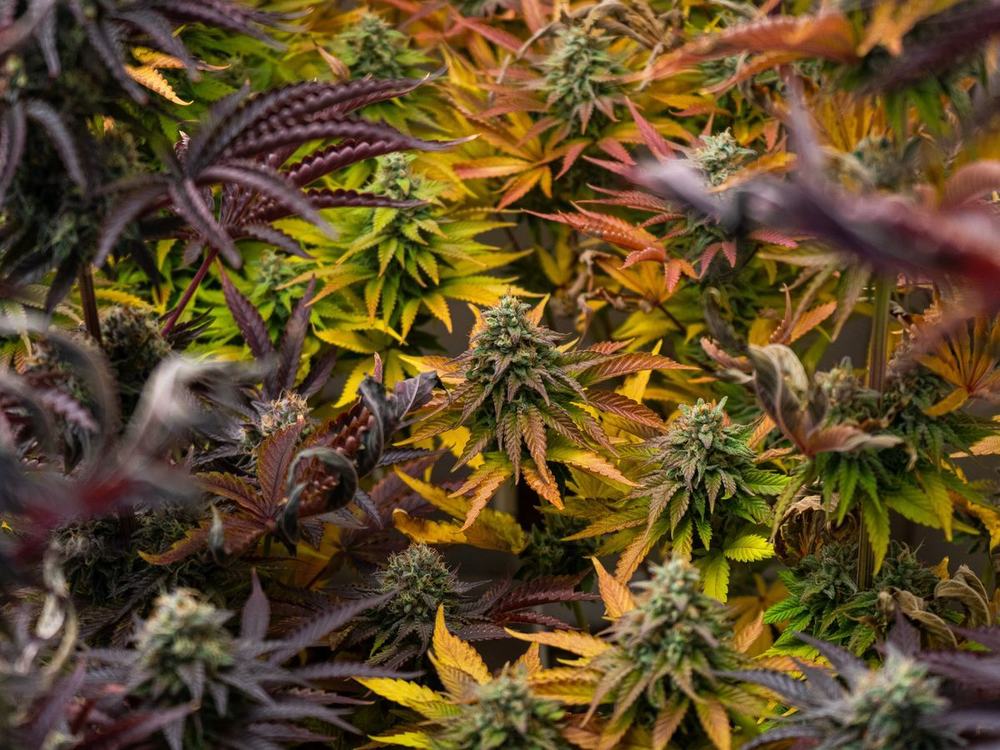
Purple stems and petioles are the one reading that is often nothing. Many strains run purple stems by genetics, and most do it in cool nights. Purple stems plus dark, dull leaves and slow growth is a phosphorus shortage. Purple stems on a plant growing fast is a trait.
How to Fix Leaf Problems
The leaf is the readout, not the patient. Every fix on the linked pages happens at the root zone, the lamp or the environment, and you judge it by the next set of leaves out, not by the damaged ones. Damaged tissue never recovers. Two checks before you change anything: test runoff pH and EC, and lift the pot. Those two readings rule half the chart in or out.
How to Prevent Leaf Problems
Walk the garden every day with the lights on and look at the undersides, not just the tops. Photograph any leaf that looks off and compare it a week later. Keep pH inside range, water by weight, and hold the canopy at 24 to 28 C. Most of the chart never happens to a grower who does those three things.
Looks Like This but Is Not
- Yellow leaves covers the six yellowing patterns in detail. Use this chart when the symptom is not yellow, or is yellow plus something else.
- Nutrient deficiencies sorts deficiencies by element with photos. Use it once the chart has pointed at the feed.
- Pests covers damage that moves: stippling, holes, webbing, frass. If the spots change position from one day to the next, it is not a deficiency.
The Mistake Most Growers Make
Diagnosing from one leaf. In eighteen years of Dear Danko letters the photo was usually a single leaf held up to the camera, and a single leaf can show four different problems the same way. Position on the plant and progression over three days are half the diagnosis. Take the whole plant shot first, then the close up.
Next Step: Fix the Feed
Once you have named the problem, go to its page, then read the nutrients chapter so the feed stops causing most of this chart. The plant problems index lists every page in this section. Cultivation is for adults where it is legal.
Looks like this, but is not?
Yellow leavesSources
- Leafly Learn: cannabis growing library (used as the general reference for leaf anatomy and leaflet counts)